Verizon vs AT&T vs T-Mobile: Activation & Setup Fee Comparison
Switching carriers or upgrading your phone? You’ll probably run into a one-time charge before your first bill even arrives. Every major U.S. carrier handles this fee differently. Each one calls it something different. Each one charges a different amount. Each one waives it under different conditions. That makes comparing Verizon, AT&T, and T-Mobile fees more confusing than it should be.
Here’s the short version. As of mid-2026, Verizon has eliminated its activation and upgrade fees for postpaid customers who join a new loyalty program. AT&T charges a standard $35 activation fee. T-Mobile charges a $35 Device Connection Charge, and it now applies almost everywhere, including purchases made through Apple. That one shift from Verizon changes the whole comparison. Most guides online haven’t caught up to it yet.
This article breaks down what each carrier charges. We’ll cover why the fee exists in the first place. And we’ll show you which company currently gives you the cheapest path to a new line of service.
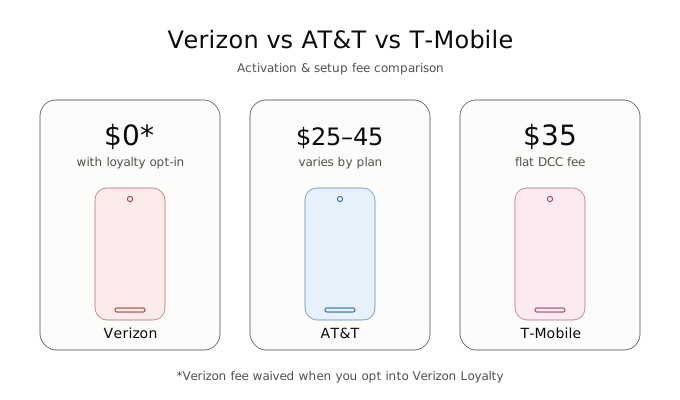
Verizon’s standard fee is $40, but you can waive it for free through Verizon Loyalty. AT&T’s fee ranges from $25 to $45, depending on your plan and how you activate. T-Mobile charges a flat $35 Device Connection Charge on nearly every activation and upgrade. Want the cheapest guaranteed path to $0? Verizon Loyalty is currently your best option. Don’t want to enroll in anything? AT&T’s BYOD rate is usually the lowest flat cost.
Below, we’ll go carrier by carrier. Then we’ll compare all three side by side. Last, we’ll cover the total cost of activating a new line, beyond just the one-time fee.
What Is a Carrier Setup Fee?
A carrier setup fee is more commonly known as an activation fee. It’s a one-time charge a wireless provider applies when it connects a new device to its network. This fee is separate from your monthly plan cost. It’s also separate from the price of the phone itself. You’ll usually see it listed as its own line item on your first bill. Carriers label it differently — “activation fee,” “device connection charge,” or “setup charge” — but it works the same way.
The fee applies in a few common situations:
- Starting brand-new service with a carrier
- Adding an additional line to an existing account
- Upgrading an existing line to a new device
- Bringing your own unlocked device and activating it on a new network
A cell phone activation fee generally covers a few tasks. The carrier provisions your SIM card or eSIM. It verifies your device is compatible. It registers your new line in its billing system. Carriers describe this as a cost-recovery charge, not a profit center. But the amount charged often exceeds what that work actually costs. That’s exactly why so many customers try to get it waived.
Why Do Carriers Charge Activation Fees?
Carriers say the fee compensates for real labor and system costs. That includes checking device compatibility, configuring network settings, and setting up billing. But in practice, most of this process is automated now, especially for online activations. That’s one reason critics see the fee as a standard revenue line rather than a true reflection of cost.
There’s also a retention angle. Activation and connection fees discourage customers from switching carriers too often. Every new line comes with its own charge, whether you’re switching providers or just adding a family member. A family activating four new lines at once could face over $100 in combined fees. That’s before a single bill for actual service even arrives.
Verizon, AT&T, and T-Mobile have all charged some version of this fee for years. What’s changed recently is that one of them has decided to stop.
A Quick History of These Fees
Activation-style fees aren’t new. They’ve existed in some form since the early days of postpaid wireless contracts. Carriers originally justified them as payment for manual paperwork and in-store labor. T-Mobile’s Device Connection Charge dates back to 2022. It started with online purchases only. Over time, it expanded to cover nearly every activation channel. As of March 2026, that includes devices bought directly through Apple. Verizon and AT&T’s fees have shifted in size and structure over the years too. They’ve moved up and down with pricing strategy changes, promotions, and competition between the three companies.
What makes 2026 different? For the first time, one of the big three has tied its fee elimination to a loyalty program instead of a short-term promotion. In the past, fee waivers from any carrier were brief marketing pushes tied to a sale event. Verizon’s approach is different. It’s a standing, opt-in program, not a limited-time deal. That’s part of why this comparison looks different than it did even six months ago.
Does Verizon Charge an Activation Fee?
Historically, yes—Verizon’s standard activation and upgrade fee sat at $40 per line, the highest among the big three carriers. Verizon also ran limited-time promotions earlier in 2026 that waived the $40 activation fee for eligible online orders, reimbursing customers through a bill credit within one or two billing cycles. If you’re looking to avoid the Verizon activation fee, it’s worth checking for the latest Verizon activation fee deals or online order promotions before signing up.
That changed in a bigger way in June 2026.
Verizon Activation Fee Amount and the 2026 Loyalty Program Change
On June 16, 2026, Verizon announced it was permanently eliminating activation and upgrade fees for postpaid customers. The change is tied to a new loyalty program called Verizon Loyalty. Any customer on a postpaid phone or connected-device plan can join for free. You do it through the My Verizon app or website. Once enrolled, you no longer pay the standard $40 activation or upgrade charge per device. The program also includes a cash-back feature called Verizon Dollars. You can apply that toward other Verizon products and services.
This rollout came with two other changes worth knowing about:
- Verizon Simplicity Plan — a streamlined unlimited plan with a single network tier and no separate activation fee structure to navigate.
- Verizon One Plan — a converged plan that bundles mobile and home internet onto one bill, with taxes and fees included in the advertised price.
So does Verizon charge an activation fee today? Technically, yes — the $40 charge still exists on paper. But it’s avoidable at no cost. Just opt into Verizon Loyalty when you activate or upgrade. That’s a real difference from AT&T and T-Mobile. Their comparable fees remain standard, and neither is tied to a free opt-in program.
Example scenario: Picture a family of four switching to Verizon. They’re adding four new lines on the Simplicity Plan. Under the old fee structure, that would mean $160 in combined activation charges. That’s before the first bill even reflects monthly service. Under Verizon Loyalty, that entire $160 disappears — as long as each line is enrolled during setup. The only cost is a few minutes spent opting in through the app.
It’s worth noting that Verizon tested shorter promotions before this announcement. Those waived the $40 fee for online orders only, and reimbursed it as a bill credit. Verizon Loyalty replaces that temporary workaround with a standing policy. That makes it a more reliable option if you’re activating outside a specific promotional window.
Verizon Upgrade Fee
The Verizon upgrade fee has historically matched the activation fee at $40 per device. It applies when an existing customer swaps their phone for a new one on the same line. Under the new Verizon Loyalty structure, this upgrade fee is waived too. It follows the same opt-in terms as the activation fee. Current customers get the same relief as new sign-ups, as long as they enroll before or during their upgrade.
Also Read: Verizon Profit Margin & Net Income Statistics 2026
Does AT&T Charge a Setup Fee?
Yes. AT&T charges a setup fee for new activations, and often for device upgrades too. Unlike Verizon’s 2026 policy shift, AT&T hasn’t announced any move to eliminate this charge. It remains a standard part of activating service.
AT&T Setup Fee Amount
The current standard AT&T activation fee for postpaid wireless service is generally $35 per line. But the exact figure depends on your plan type and how you activate:
- Bring-your-own-device or no-contract activation: around $25 per line
- Standard postpaid activation: around $35 per line
- Device upgrade or subsidized-device activation: as high as $45 per line in some cases
Because AT&T’s fee schedule is subject to change and can vary by promotion, region, and plan tier, it’s worth confirming the AT&T activation fee before buying or the exact charge at checkout—whether you’re activating online, in an AT&T store, or over the phone. AT&T typically itemizes the charge clearly on your first bill rather than folding it into the plan price.
AT&T Fee by Plan Type
A few patterns show up consistently across AT&T’s current fee structure:
- Online activations are more likely to qualify for a promotional waiver than in-store activations.
- Prepaid AT&T plans generally carry the lowest activation cost, often around $25, with no long-term contract attached.
- Bundling wireless with AT&T internet or TV service can sometimes unlock reduced setup costs as part of a package promotion.
Comparing verizon vs att vs t-mobile fees side by side, AT&T sits in the middle. It’s not free like an opted-in Verizon Loyalty member. But it’s generally on par with, or slightly below, T-Mobile’s flat charge.
It’s also worth knowing that AT&T reserves the right to change these charges at any time. The company keeps separate fee schedules for consumer accounts versus business, government, and other non-consumer accounts. If you’re activating a business line, don’t assume consumer pricing will match your invoice. Business agreements follow a completely separate fee schedule.
Example scenario: Say a customer brings their own unlocked iPhone to AT&T and activates a no-contract plan online. They’d likely land at the lower end of the range, around $25. Now say another customer walks into a retail store to activate a new financed device on a standard postpaid plan. They’re more likely to see the full $35 to $45 charge, based on the channel and plan type involved.
How Much Is T-Mobile’s Activation Fee?
T-Mobile doesn’t actually use the term “activation fee” in its billing. Instead, it calls the charge a Device Connection Charge, or DCC. Functionally, it works the same way. It’s a one-time, per-line charge applied when you activate a new line or upgrade an existing device.
T-Mobile Activation Fee Amount
The T-Mobile Device Connection Charge is a flat $35 per line. It applies to:
- New line activations
- Device upgrades on an existing line
- Any device type connecting to the network — smartphones, tablets, or smartwatches with their own connection
This charge is per line, not per account. So a family activating or upgrading three phones at once would see $105 in combined connection charges. That’s before any device or plan cost is even factored in.
T-Mobile introduced the DCC back in 2022, and its scope has grown since then. As of March 27, 2026, T-Mobile closed a popular workaround. Buying a device directly through Apple’s stores, website, or app no longer exempts you from the $35 charge. In that case, the fee doesn’t show up upfront at checkout. Instead, it’s added to your T-Mobile account and appears on the following month’s bill.
How to Avoid the T-Mobile DCC
A few legitimate options remain for sidestepping the Device Connection Charge:
- Costco or Sam’s Club membership: Both warehouse retailers currently waive the $35 DCC as a membership perk when you activate or upgrade T-Mobile service through their wireless kiosks.
- Limited-time promotions: T-Mobile periodically waives the DCC for new online-only line activations, especially around major device launches or holiday sales windows. These offers tend to be temporary, and they usually don’t apply to upgrades.
- Bring your own device without activating a new line: No connection charge applies if you’re not adding a new line or upgrading.
Outside of these paths, the DCC has become close to unavoidable. That’s true for most new activations and upgrades, especially now that the Apple-purchase loophole has closed.
Here’s a detail that surprises a lot of customers. T-Mobile bundles a small perk into the DCC on qualifying voice lines. When you activate a new device and pay the connection charge, you also get a one-time hotspot data pass. It’s good for 30 days and 20GB of high-speed data. T-Mobile adds it to your account automatically, usually within 24 to 48 hours of activation. It doesn’t offset the cost of the fee. But it’s worth knowing about, so you’re not caught off guard when it shows up.
Example scenario: A customer upgrades their phone through the T-Mobile app. They pay the standard $35 DCC, and it shows up as a separate charge alongside their prorated plan cost. Now picture a different customer buying the same phone directly from Apple’s website, using T-Mobile financing. They’ll pay the same $35 DCC. It just won’t appear at the Apple checkout screen. Instead, it lands on the following month’s T-Mobile bill, since Apple’s checkout system doesn’t support carrier-added fees.
Verizon vs AT&T vs T-Mobile: Fees Comparison Table
Here’s how the three major carriers stack up on activation and setup charges as of mid-2026:
| Carrier | Official Fee Name | Standard Amount | Applies To | Common Waiver Path |
|---|---|---|---|---|
| Verizon | Activation / Upgrade Fee | $40 (waived with Verizon Loyalty opt-in) | New lines, upgrades | Free Verizon Loyalty enrollment |
| AT&T | Activation Fee | $25–$45 depending on plan/channel | New lines, some upgrades | Online activation promos, BYOD, prepaid |
| T-Mobile | Device Connection Charge (DCC) | $35 flat | New lines, upgrades, all device types | Costco/Sam’s Club, limited-time online promos |
A few takeaways stand out from this comparison:
- Verizon currently offers the clearest path to a $0 fee. The free Verizon Loyalty program makes that possible, but only if you actively opt in.
- AT&T has the widest fee range. Your actual charge depends heavily on plan type and activation channel.
- T-Mobile has the least flexibility. Its flat $35 DCC now applies almost everywhere, including the Apple purchase channel that used to be exempt.
Carrier Switching Fees: What Else to Budget For
Activation and setup charges aren’t the only carrier switching fees you might run into. A few others are worth budgeting for:
- SIM or eSIM starter kit fees. Sometimes bundled into the activation charge, sometimes billed separately, depending on the carrier and purchase channel.
- Early termination fees from your old carrier. These can apply if you’re still under a device financing agreement or promotional contract.
- Number transfer (porting) issues. Porting is typically free, but mismatched account details between carriers can cause delays.
- Restocking fees. These can run as high as $55 if you return or exchange a device after the standard return window closes.
- Regulatory and telco recovery fees. These are recurring monthly charges layered on top of your plan price, separate from any one-time activation cost.
None of these fees are unique to one carrier. But they add real cost to a switch. Check your current provider’s exit terms before assuming the new carrier’s fee is your only expense.
Prepaid vs. Postpaid Fee Differences
It’s also worth separating postpaid and prepaid pricing when you budget for a switch. Across all three carriers, prepaid plans generally carry lower or no activation charges compared to postpaid service. That’s because prepaid accounts skip credit checks, device financing agreements, and long-term contracts. AT&T’s prepaid tier, for example, typically runs a flat $25 activation cost. There’s no early termination risk either, since there’s no contract to break. Verizon and T-Mobile follow a similar pattern with their prepaid sub-brands. Fees there tend to run lower than the postpaid rates covered in this comparison.
Want to minimize every possible one-time charge? A prepaid plan on any of these three networks is generally the cheaper starting point. Just know you’ll give up some postpaid perks, like device trade-in promotions.
New Line Activation Cost: Total Price Breakdown
When people ask about new line activation cost, they’re often picturing the activation fee alone. In reality, the total cost of starting a new line includes several parts stacked together:
- The activation or connection fee itself — $0–$45 depending on carrier and eligibility for a waiver.
- Prorated plan charges for the remaining days in your first billing cycle.
- Device cost or first equipment installment payment, if you’re financing a new phone rather than bringing your own.
- Taxes and regulatory fees, which vary by state and apply on top of both the plan and any one-time fees.
- SIM or eSIM costs, occasionally itemized separately from the activation charge.
For a single new line with a BYOD (bring your own device) setup, total one-time costs typically fall between $0 and $45 before taxes. You’ll land at $0 with Verizon Loyalty, a T-Mobile promo, or an AT&T online waiver. Add a financed device, and the upfront cost climbs based on the phone itself.
Phone Setup Fee Cost by Purchase Channel
Where and how you activate service can meaningfully change your phone setup fee cost. This holds true no matter which of the three carriers you choose. A consistent pattern shows up across Verizon, AT&T, and T-Mobile:
- Activating online tends to carry the best odds of a waived or reduced fee. It requires less in-person staff time, and carriers frequently push customers toward self-service channels with online-exclusive promotions.
- Activating in a retail store is more likely to include the full standard fee. That said, in-store reps sometimes have discretion to waive it as a courtesy, particularly for long-tenured customers.
- Activating through a third-party retailer like Best Buy, Costco, or Sam’s Club can unlock retailer-specific waivers. Costco and Sam’s Club, for instance, currently waive T-Mobile’s DCC entirely for members.
- Activating through a carrier’s own app (like My Verizon or T-Life) often mirrors the online waiver terms available on the website.
If minimizing cost is your priority, start the process online or through a warehouse club membership. That’s generally your best bet across all three carriers.
Which Carrier Has the Cheapest Setup Fee for a New Line?
Based on current 2026 pricing, here’s how the cheapest carrier for new line activation shakes out, depending on your situation:
- Willing to opt into a loyalty program? Verizon wins outright. Verizon Loyalty members pay $0 in activation or upgrade fees.
- Want the lowest fee without any enrollment step? AT&T’s BYOD or prepaid activation fee, often around $25, tends to be the lowest flat charge among the three.
- Have a Costco or Sam’s Club membership? T-Mobile becomes free to activate, matching Verizon’s Loyalty-based waiver.
- None of the above apply to you? AT&T and T-Mobile land in a similar $35 range. Verizon’s standard $40 fee is the highest baseline if you skip the Loyalty opt-in.
The practical answer to “which carrier is cheapest” now depends less on the sticker price of the fee. It depends more on whether you’re willing to take an extra step — enrolling in a loyalty program, shopping through a warehouse club, or activating online instead of in-store.
Best Carrier With No Activation Fee
If your goal is a $0 activation fee specifically, your realistic options in 2026 are:
- Verizon, for any postpaid customer who opts into the free Verizon Loyalty program before activating or upgrading.
- T-Mobile, if you have a Costco or Sam’s Club membership, or if you catch one of T-Mobile’s periodic online-only promotional waivers.
- AT&T, occasionally, through limited-time online activation promotions. This isn’t a standing policy the way Verizon’s Loyalty program is.
Verizon is currently the only one of the three offering a standing, no-cost path to a waived fee that doesn’t require a membership. It just requires opting into a program, rather than the fee being eliminated outright for everyone.
How to Avoid Carrier Fees When Switching
No matter which carrier you’re headed to, a few habits consistently improve your odds of avoiding activation-related fees:
- Activate online instead of in-store. All three carriers show a pattern of favoring digital-only waivers over in-person activations.
- Ask directly before you commit. A simple request — “can this fee be waived since I’m switching my whole family over?” — works more often than people expect. Longer-tenured reps especially have discretion to apply courtesy credits.
- Check warehouse club deals first. If you’re already a Costco or Sam’s Club member, activating T-Mobile service through their wireless counter can eliminate the DCC entirely.
- Time your switch around major sales periods. Back-to-school season, Black Friday, and new device launch windows are when carriers most often run fee-waiver promotions to win new customers.
- Opt into loyalty or rewards programs at signup, not after. Verizon’s fee waiver, for example, is tied to enrolling in Verizon Loyalty. It’s worth doing during the activation process, not assuming it applies automatically.
- Compare the total first-bill cost, not just the advertised plan price. A carrier with a lower monthly rate but a higher activation fee might not actually be cheaper for your first month.
How to Spot These Fees on Your First Bill
Even if you think you’ve avoided a setup fee, double-check your first statement carefully. Here’s what to look for:
- Verizon: Look for a line item labeled “Activation Fee” or “Upgrade Fee.” If you enrolled in Verizon Loyalty but still see the charge, check the timing. The waiver applies at the point of enrollment, not always retroactively.
- AT&T: The charge typically appears as “Activation Fee” or occasionally “Upgrade Fee.” It’s itemized separately from your plan cost and any device installment payment. If a promotion was supposed to waive it, confirm the waiver applied as a credit. Some AT&T promotions charge the fee upfront and reimburse it later.
- T-Mobile: Look for “Device Connection Charge” or the abbreviation “DCC.” If you bought through Apple, remember this charge won’t show up at the Apple checkout. It appears on your next T-Mobile bill instead, which catches a lot of customers off guard the first time.
If a fee you expected to be waived shows up anyway, contact the carrier directly. Reference the specific promotion, program enrollment, or membership perk you qualified for. Billing errors on one-time fees are common, and most carriers have a straightforward process for correcting them. Just catch it within a billing cycle or two.
Verizon vs AT&T vs T-Mobile Fees: The Bottom Line by Use Case
Depending on what matters most to you, the “best” answer to this comparison changes:
- Switching your whole family at once: Verizon Loyalty offers the biggest combined savings. The waiver applies per line, with no cap on how many lines you enroll.
- Adding a single line with no interest in loyalty programs: AT&T’s BYOD rate tends to be the cheapest flat charge available, with no extra enrollment step.
- Already a Costco or Sam’s Club member: T-Mobile becomes a free activation, putting it on par with Verizon Loyalty for that group of shoppers.
- Buying a new iPhone directly from Apple: Verizon or AT&T currently offer better odds of avoiding a connection charge than T-Mobile, now that T-Mobile’s Apple-channel exemption has ended.
- Prioritizing the lowest total first-bill cost overall: Compare the fee alongside taxes, prorated plan charges, and any device installment. The cheapest fee doesn’t always mean the cheapest first bill.
Frequently Asked Questions
Does Verizon charge an activation fee?
Verizon’s standard activation and upgrade fee is $40 per line. But as of June 2026, postpaid customers can avoid it entirely by opting into the free Verizon Loyalty program.
Does AT&T charge a setup fee?
Yes. AT&T charges a setup fee that typically ranges from $25 to $45. The amount depends on your plan type and whether you’re activating a new line, bringing your own device, or upgrading.
How much is T-Mobile’s activation fee?
T-Mobile calls it a Device Connection Charge. It’s a flat $35 per line for new activations and device upgrades, including devices purchased through Apple as of March 2026.
Why do carriers charge activation fees?
Carriers frame activation fees as recovery costs for provisioning a device, verifying network compatibility, and setting up billing. But the charge also works as a deterrent against frequent line changes and carrier switching.
Which carrier has the cheapest setup fee for a new line?
Verizon currently offers the clearest path to $0 through its free Loyalty program. AT&T’s BYOD rate, around $25, is typically the lowest flat fee among the three carriers.
Is there a carrier with no activation fee at all?
Verizon effectively has no activation fee for customers who opt into Verizon Loyalty. T-Mobile customers with a Costco or Sam’s Club membership can also avoid its Device Connection Charge.
Do prepaid plans have lower activation fees than postpaid plans?
Generally, yes. Prepaid plans across Verizon, AT&T, and T-Mobile tend to carry lower one-time activation costs than postpaid plans. There’s no credit check, contract, or device financing agreement involved.
Can I get a carrier to waive the activation fee just by asking?
Sometimes. Retail and customer service reps often have discretion to apply a courtesy waiver. This is especially true for long-tenured customers or those switching multiple lines at once. It’s not guaranteed, though, and it varies by carrier and representative.
Final Thoughts
The gap between Verizon, AT&T, and T-Mobile on activation and setup fees has narrowed and shifted in 2026. Verizon’s move to eliminate its fee through a free loyalty opt-in is a genuine differentiator. That’s especially true for anyone who found the old $40 charge to be the most frustrating part of switching or upgrading. AT&T remains the most variable, with pricing that depends heavily on plan type and purchase channel. Meanwhile, T-Mobile’s flat $35 Device Connection Charge has actually become harder to avoid, now that its Apple-purchase loophole has closed.
If avoiding fees entirely is your priority, check whether you qualify for Verizon Loyalty or a Costco/Sam’s Club membership before you activate. If you’re comparing pure sticker price without any extra steps, AT&T’s BYOD rate currently edges out the competition. Either way, confirm the exact fee and any active promotions directly with the carrier before you complete your order. These charges — and the ways to waive them — keep changing throughout the year.