Verizon Statistics 2026: Revenue, Subscribers & Market Share
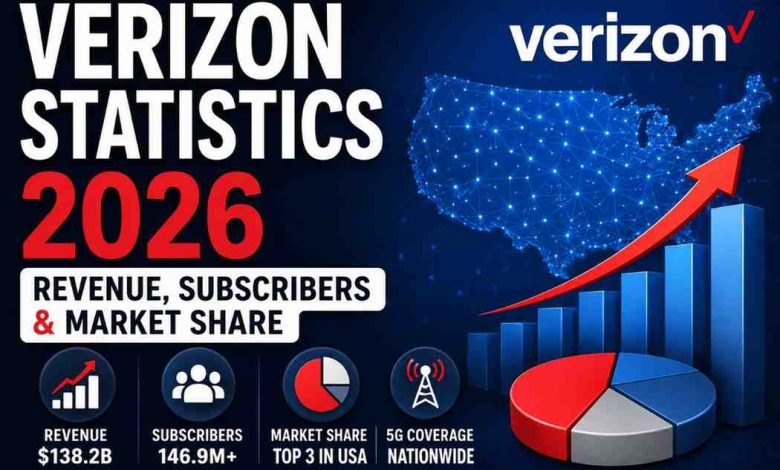
Verizon Communications remains one of the largest telecommunications companies in the United States, and these verizon statistics show why. As the country’s biggest wireless carrier by subscriber count, Verizon has built its business on a mix of wireless service, fixed wireless and fiber broadband, and a growing enterprise division. Heading into 2026, the company is in the middle of a turnaround push under new leadership, betting on subscriber growth, a major fiber acquisition, and continued 5G expansion to fend off T-Mobile and AT&T.
verizon revenue by year, total wireless and broadband subscribers, market share versus competitors, 5G coverage, and where the business segments stand today. Whether you’re researching the company for investment purposes, comparing carriers before switching, or just want a clear picture of where Verizon stands in 2026, the data below is pulled from Verizon’s own financial filings, SEC reports, and independent industry trackers.
Verizon Statistics 2026
Key Verizon Statistics
- Verizon generated $138.2 billion in total operating revenue for full-year 2025.
- Verizon serves roughly 146 million wireless subscribers, including both retail and wholesale connections.
- Verizon holds approximately 34% of the U.S. wireless subscriber market, putting it neck-and-neck with T-Mobile for the top spot.
- Verizon Business Group contributed about 21% of total company revenue in 2025.
- Verizon’s 5G Ultra Wideband network reaches more than 250 million people across the United States.
- Verizon remains one of the largest telecommunications companies in the U.S. by revenue and the largest by total wireless connections.
Verizon Statistics 2026 Highlights
| Metric | Value |
|---|---|
| Annual Revenue (FY2025) | $138.2 billion |
| Wireless Subscribers | ~146 million |
| Broadband Connections | ~11 million (Consumer) + ~3 million (Business) |
| Market Share (wireless subscribers) | ~34% |
| 5G Ultra Wideband Reach | 250+ million people |
| Business Segment Revenue | $29.1 billion |
Verizon Revenue Statistics
Verizon Revenue by Year (2021–2026)
| Year | Revenue |
|---|---|
| 2021 | $133.6 billion |
| 2022 | $136.8 billion |
| 2023 | $134.0 billion |
| 2024 | $134.8 billion |
| 2025 | $138.2 billion |
| 2026 (TTM, as of Q1) | $139.1 billion |
Key Revenue Insights
- Revenue growth trend: After a dip in 2023, Verizon’s revenue has grown for two straight years, with 2025 marking the strongest year in the five-year stretch — a 2.5% increase over 2024.
- Wireless service revenue contribution: Wireless service revenue remains the backbone of the business, with Q4 2025 wireless service revenue alone reaching $21.0 billion, up 1.1% year-over-year.
- Business revenue contribution: The Verizon Business Group generated $29.1 billion in 2025, a continued decline from $31.0 billion in 2021 as legacy wireline and wholesale revenue keeps shrinking.
- Consumer segment performance: The Verizon Consumer Group is the clear growth engine, posting $106.8 billion in 2025 revenue, up from prior years and now the largest single driver of company-wide growth.
Verizon Revenue Facts
- Verizon’s full-year 2025 net income came in at $17.6 billion, a slight dip from 2024’s $17.5–17.9 billion range.
- Operating income for 2025 was $32.2 billion, helped by cost management and higher revenue.
- Total unsecured debt stood at roughly $119.7 billion as of Q3 2025, down from $126.4 billion a year earlier.
- Verizon’s board approved a $25 billion share repurchase program alongside plans to return about $55 billion to shareholders through 2028.
- The January 2026 completion of the Frontier acquisition pushed Verizon’s fiber footprint to more than 30 million homes and businesses, a deal that will materially reshape revenue mix going forward.
Verizon Subscriber Statistics
Total Subscribers
Verizon ended 2025 with approximately 146 million total wireless subscribers, maintaining its position as the largest U.S. wireless carrier by subscriber count, narrowly ahead of T-Mobile.
Wireless Subscribers
The company reported around 116 million wireless retail connections as of December 31, 2025, split between consumer and business accounts, plus wholesale and other connections that bring the total subscriber base closer to 146 million.
Consumer Subscribers
The Verizon Consumer Group accounted for the bulk of retail connections, with roughly 93–116 million wireless retail connections depending on the reporting period in 2025, alongside steady postpaid phone net additions — 616,000 in Q4 2025 alone, the best quarterly result since 2019.
Business Subscribers
Verizon Business had about 31 million wireless postpaid connections as of the end of 2025, serving enterprise, government, and small-business customers, plus roughly 3 million broadband connections.
Broadband Subscribers
Verizon’s fixed wireless access (FWA) base topped 5.7 million subscribers by the end of 2025, while total broadband connections (Fios fiber plus FWA) exceeded 13.2 million as of Q3 2025 — an 11.1% year-over-year increase. The Frontier acquisition, completed in January 2026, is expected to push the company’s addressable fiber footprint well beyond that.
| Subscriber Type | Total (approx.) |
|---|---|
| Total Wireless | 146 million |
| Consumer Wireless Retail | ~93–116 million |
| Business Wireless Postpaid | ~31 million |
| Fixed Wireless Access | 5.7 million |
| Total Broadband Connections | 13.2+ million |
Verizon Market Share Statistics
U.S. Wireless Carrier Market Share
Market share figures vary slightly by source and measurement period, but Verizon, T-Mobile, and AT&T together control nearly the entire U.S. wireless market. As of late 2025/early 2026 estimates:
| Carrier | Market Share (approx.) |
|---|---|
| Verizon | ~34% |
| T-Mobile | ~35% |
| AT&T | ~27% |
| Others (MVNOs, regional carriers) | ~4% |
Market Share Insights
- Verizon ranking: Verizon and T-Mobile are essentially tied for the top spot by subscriber count, with some quarters favoring one carrier over the other depending on net additions; Verizon has historically led on raw subscriber totals while T-Mobile has gained ground faster.
- Competitive position: Industry analysts describe the current market as “the great convergence” — a shift from Verizon’s historical dominance toward a tighter three-way race as T-Mobile and AT&T post stronger net adds and narrower profitability gaps with Verizon.
- Industry trends: AT&T trails in subscriber share but has been closing the gap through aggressive fiber and 5G investment, while smaller players like cable MVNOs (Spectrum Mobile, Xfinity Mobile) are slowly chipping away at all three majors’ incremental growth.
Verizon 5G Statistics
Verizon 5G Coverage
Verizon’s 5G Ultra Wideband network — its highest-performance 5G tier — now reaches more than 250 million people nationwide, while its broader 5G Nationwide network using low-band spectrum covers an even larger footprint. Verizon’s combined 4G LTE and 5G network reaches about 99% of the U.S. population.
Verizon 5G Subscribers
Verizon doesn’t break out a single “5G subscriber” figure publicly, but the vast majority of its postpaid phone base now uses 5G-capable devices on 5G-enabled plans, and 5G fixed wireless access has become a meaningful growth driver, with FWA subscribers surpassing 5.7 million by the end of 2025.
Verizon Network Expansion
Verizon has continued building out C-Band spectrum to expand Ultra Wideband capacity, while the Frontier and Starry acquisitions — both completed in January 2026 — extend the company’s fiber and fixed wireless broadband reach into new states and markets.
Key 5G Facts
- Verizon’s 5G Ultra Wideband footprint has grown from roughly 175 million people covered in 2022 to over 250 million people today.
- Average 5G download speeds on Verizon’s Ultra Wideband network reportedly fall in the 150–200 Mbps range, ahead of AT&T’s typical 120–150 Mbps range.
- Verizon posted the highest coverage score among the three major U.S. carriers in Ookla’s H1 2025 Speedtest Connectivity Report.
- Fixed wireless access net additions reached 319,000 in Q4 2025 alone, bringing the FWA subscriber base past 5.7 million.
Verizon Business Statistics
Enterprise Revenue
Verizon Business Group revenue came in at $29.1 billion for full-year 2025, continuing a multi-year decline from $31.0 billion in 2021 as wholesale and traditional wireline revenue shrinks faster than newer business lines can offset it.
Business Customers
Verizon Business served roughly 31 million wireless postpaid connections and about 3 million broadband connections as of the end of 2025, spanning small businesses, large enterprises, government agencies, and carrier wholesale relationships.
Cloud & Security Services
Verizon continues to position its Business segment around private 5G networks, mobile edge compute, and managed security services for enterprise customers, though these newer lines remain a small share of overall Business Group revenue compared to core wireless and wireline.
Business Growth Metrics
Business wireless service revenue grew modestly through 2025 — up 0.7% year-over-year in Q3 2025 to $3.6 billion — but overall segment revenue continues to decline due to ongoing softness in wholesale and legacy wireline products.
https://www.stock-analysis-on.net/NYSE/Company/Verizon-Communications-Inc/Analysis/Revenues
Verizon vs AT&T vs T-Mobile
| Metric | Verizon | AT&T | T-Mobile |
|---|---|---|---|
| FY2025 Revenue | $138.2 billion | $125.6 billion | ~$85.8 billion |
| Wireless Subscribers (approx.) | ~146 million | ~119 million | ~140 million |
| Wireless Market Share | ~34% | ~27% | ~35% |
| 5G Coverage Strategy | Ultra Wideband + Nationwide, 250M+ people | Mid-band 5G, broad fiber overlap | Largest claimed 5G footprint by population |
Key Comparison Insights
Verizon leads all three carriers on total company revenue, largely because of its size and broadband/Fios business, even though T-Mobile has pulled essentially even — or ahead, depending on the quarter — in wireless subscriber count. AT&T trails both in subscribers but has narrowed the revenue gap through fiber growth and disciplined cost control.
T-Mobile continues to post the fastest growth rate of the three, driven by industry-leading postpaid net additions and aggressive expansion into fiber and fixed wireless broadband through acquisitions like UScellular, Metronet, and Lumos.
Verizon Growth Trends (2021–2026)
Revenue Growth
Verizon’s revenue dipped in 2023 before recovering through 2024 and accelerating in 2025, with the 2.5% year-over-year increase representing the company’s strongest growth in this five-year window. Trailing twelve-month revenue through Q1 2026 reached $139.1 billion.
Subscriber Growth
After a slower stretch, Verizon’s Q4 2025 postpaid phone net additions of 616,000 marked the company’s best quarterly performance since 2019, and combined mobility-and-broadband net additions topped 1 million for the quarter — also a post-2019 high.
Market Share Trend
Verizon’s wireless subscriber share has been gradually eroding relative to T-Mobile over the past several years as T-Mobile’s aggressive un-carrier strategy and acquisitions (Sprint, UScellular) have closed the gap, even as Verizon retains the edge in network coverage scores and total revenue.
Expert Analysis
Why Verizon remains competitive:
Verizon’s network reliability scores and broad geographic 5G coverage continue to be its biggest competitive advantages, particularly in rural and suburban markets where its legacy infrastructure investment gives it an edge over T-Mobile’s more urban-centric buildout.
Revenue diversification:
The 2025–2026 acquisitions of Frontier and Starry mark Verizon’s biggest strategic shift in years, pushing the company toward a converged wireless-plus-fiber model similar to what T-Mobile and AT&T have pursued, rather than relying solely on wireless service revenue.
Future challenges:
The Business Group’s ongoing revenue decline, driven by legacy wireline and wholesale erosion, remains a structural drag that Consumer segment growth has to outrun. Verizon also carries a heavier debt load than its rivals, which constrains some capital flexibility even as the company commits to large shareholder returns.
Growth opportunities:
Fixed wireless access and fiber broadband (newly bolstered by Frontier) represent Verizon’s clearest paths to subscriber growth outside of the maturing core wireless market, alongside enterprise private-network and edge-compute offerings that are still in early stages of scaling.
Future Outlook for Verizon
2027 Predictions
- Subscriber growth outlook: Verizon’s “play to win” turnaround strategy, paired with the Frontier integration, is expected to push postpaid and broadband net additions higher through 2026–2027, though it will likely still trail T-Mobile’s pace of growth.
- 5G expansion outlook: Continued C-Band buildout should push Verizon’s Ultra Wideband coverage further past the 250-million-person mark, with fixed wireless access remaining the fastest-growing piece of the network business.
- Business segment outlook: Expect the Business Group’s revenue decline to continue moderating as wholesale and wireline legacy products shrink toward a smaller share of the overall mix, while private networks and managed services slowly scale.
- Revenue forecast: With Frontier now fully integrated and wireless service revenue still growing low single digits, most analysts expect Verizon’s top line to keep climbing modestly through 2026 and 2027, potentially approaching or exceeding $145 billion in annual revenue if current trends hold.
Frequently Asked Questions
What is Verizon’s revenue in 2026?
Verizon hasn’t reported full-year 2026 results yet, but trailing twelve-month revenue through Q1 2026 stood at $139.1 billion, up nearly 3% year-over-year. Full-year 2025 revenue was $138.2 billion, so 2026 is on pace to come in modestly higher.
How many subscribers does Verizon have?
Verizon serves approximately 146 million total wireless subscribers as of late 2025, making it the largest U.S. wireless carrier by subscriber count, alongside roughly 13 million-plus broadband connections across Fios fiber and fixed wireless access.
What is Verizon’s market share?
Verizon holds roughly 34% of the U.S. wireless subscriber market, putting it in close competition with T-Mobile (around 35%) for the top spot, while AT&T trails at around 27%.
Is Verizon bigger than AT&T?
By total company revenue, yes — Verizon’s $138.2 billion in 2025 revenue outpaced AT&T’s $125.6 billion. By wireless subscriber count, Verizon also leads, with roughly 146 million subscribers versus AT&T’s approximately 119 million.
Is Verizon the largest telecom company in the U.S.?
Verizon is the largest U.S. telecom by total revenue and by wireless subscriber count, though T-Mobile has pulled close in subscribers and AT&T remains competitive in fiber broadband and overall scale.
How many 5G customers does Verizon have?
Verizon doesn’t publish an exact 5G subscriber count, but its 5G Ultra Wideband network now reaches over 250 million people, and the large majority of its postpaid base uses 5G-capable plans and devices, with 5G fixed wireless access alone surpassing 5.7 million subscribers.
Sources
- Verizon Annual Reports and 10-K Filings (SEC)
- Verizon Q3 2025, Q4 2025, and Full-Year 2025 Earnings Releases
- AT&T Inc. 8-K Filings and Earnings Reports
- T-Mobile US, Inc. 8-K Filings and Earnings Reports
- MacroTrends Historical Financial Data
- Ookla Speedtest Connectivity Report, H1 2025
- TelecomLead Carrier Comparison Reports
- Statista and IBISWorld Industry Market Share Data
Conclusion
Verizon closes out 2025 and heads into 2026 as the largest U.S. telecom by revenue, with $138.2 billion in annual revenue and roughly 146 million wireless subscribers. The company holds onto its position at or near the top of the wireless market share rankings — though T-Mobile is right behind it — while its 5G Ultra Wideband network now covers more than a quarter-billion Americans.
The newly closed Frontier acquisition signals a real strategic pivot toward converged fiber-and-wireless growth, even as the Business Group’s steady revenue decline remains a challenge to watch. With strong Q4 2025 net additions and an aggressive shareholder-return plan in place, Verizon’s 2026–2027 outlook points to continued, if modest, growth.
Curious whether Verizon’s current plans, deals, or promotions are the right fit for you? It’s worth comparing current Verizon deals and discounts before you sign up or switch.